In the years before the American Revolution, Nassau Hall stood as a beacon of learning and quiet collegiate life. One student noted in 1769 that “the students live in perfect peace, & harmony, I know of no uneasiness amongst them from any quarter whatsoever.”
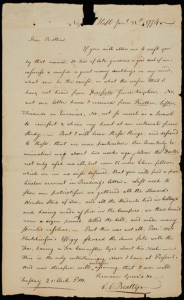
Just a few years later, much had changed. In 1775, on the eve of Revolution, another student wrote that “You need not speak here [unless] it is about Liberty … every man handles his Musket and hastens in his preparations for war.”
Two new exhibitions explore the role of Princeton and Princetonians during the American Revolution
Nursery of Rebellion: Princeton & the American Revolution is a new exhibition opening this spring in Princeton University Library’s Milberg Gallery. Curated by Michael Blaakman, Associate Professor of History and Gabriel Swift, Librarian for Early American Collections, it weaves together a vast array of rare books, manuscripts, artworks, and objects to trace how the American Revolution seized this sleepy, studious town with revolutionary fervor. Seeing the Revolution through a local lens, Nursery of Rebellion explores the diversity of revolutionary experiences. Not only on the battlefield and at the statehouse but also in ordinary people’s homes, shops, and classrooms, this exhibition showcases the University’s archival treasures and lesser-known sources to investigate the Revolution across differences of background, status, and allegiance.
The Revolution touched Princeton residents in numerous ways. Students participated in early protests, rioting and burning effigies of hated British politicians. John Witherspoon, President of the college, went on to sign the Declaration of Independence, but, not long after, troops marched into Princeton’s farmland, transforming the town itself into a violent battleground. Once independence was finally secured, the Continental Congress came to Princeton to sort out how to govern a new nation. Throughout the upheaval, enslaved people seized opportunities to gain freedom; Native nations negotiated with competing powers; ordinary citizens seized opportunities or lost everything.
Artifacts from this period, long tucked away in Princeton’s University Library’s Special Collections, will be on display for viewers, opening windows into what Princeton was like during this immensely turbulent time.
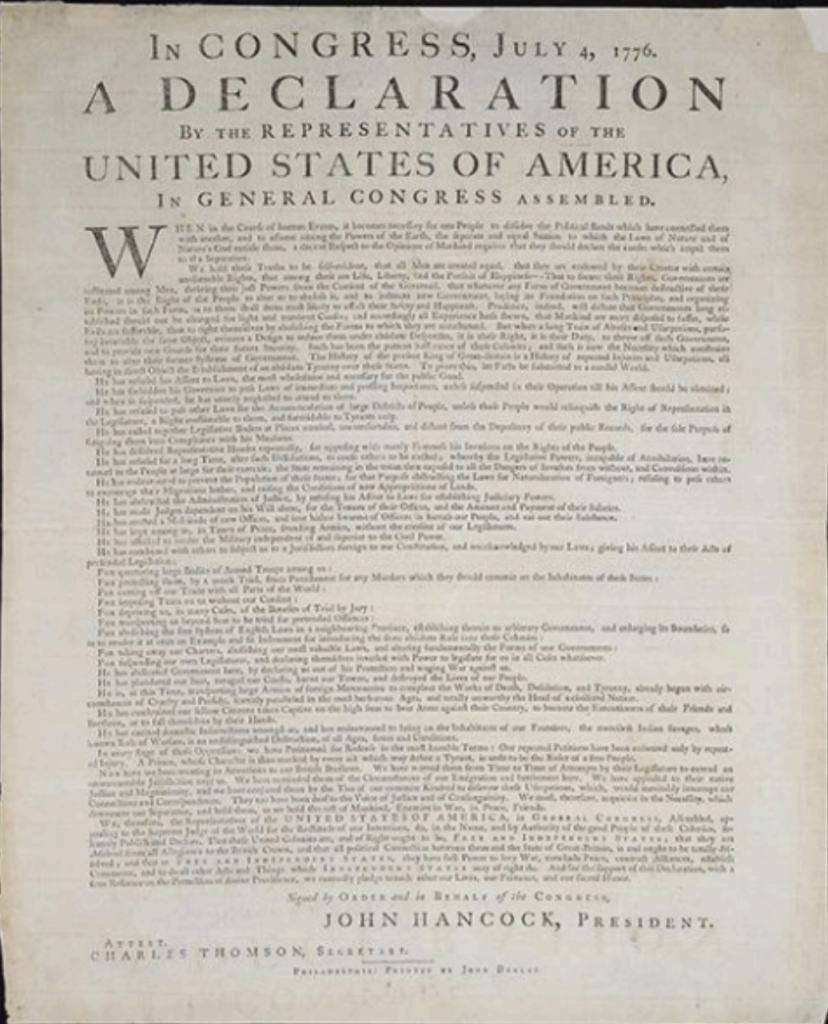
One of the earliest printed copies of the Declaration of Independence, of which only 26 are known to survive, might have been posted in a tavern or read aloud in a courthouse square.
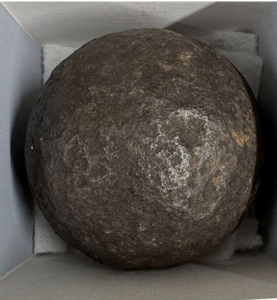
A cannonball that blasted across a field during the Battle of Princeton was lodged in the earth for nearly a century before it was found.
Student letters convey a sense of chaos, urgency, and passion that overtook the town, while Loyalist tracts pose scathing critiques of the violent radicals.
Petitions from enslaved people stand just across from letters written by figures such as George Washington, James Madison, and Thomas Jefferson.
Eventually, all of these objects found their way into Princeton University Library’s Special Collections. Some traveled far to get here, like the French draft copy of the Franco-American alliance treaty. Others were crafted mere minutes away, such as the sermons that Princeton President John Witherspoon preached in 1776 to rally students and foster revolutionary fervor before heading off to the Continental Congress.
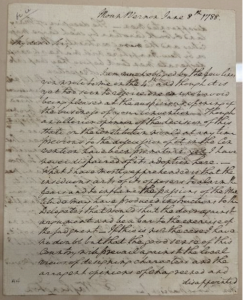
How do these objects tell a story? When placed alongside each other, how do they speak to each other? Themes and threads emerged slowly through this process. As viewers walk through the gallery, they’ll follow the national story of the Revolution—from the Stamp Act to the Battle of Yorktown to the ratification of the Constitution—alongside local perspectives from Princeton inhabitants, representing how war impacted the everyday lives of men and women, patriot and loyalist, free and enslaved, Black and White and Native.
In one case, maps of the Battle of Yorktown add color and context to letters written by Alexander Hamilton, who, at the time, was a young aide-de-camp in the Continental Army during the battle. In another corner of the gallery, an engraving of Nassau Hall and a portrait of an undergraduate student sit next to a bill of sale for a person enslaved by the college President, revealing how profoundly unequal lives could unfold within the same small community, shedding light onto a world in which aspiration, coercion, hope, and contradiction existed side by side.
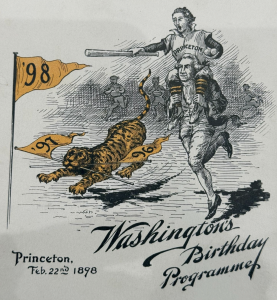
Another exhibition on Princeton’s campus will trace this revolutionary moment and its lasting impact. At the Mudd Manuscript Library, Real and Remembered: Princetonians Caught Between Study and Revolution, will show how the Revolution was a key part of institutional identity and school spirit. Students fought with their counterparts at Rutgers University over control of abandoned British weapons, ultimately making a cannon a symbol of Princeton. A mythological George Washington transformed into a friendly mascot who enjoyed the company of Princeton’s mascot tiger and helped with athletic victories. Though often somber, as in times of war or national grief, some patriotic celebrations took on an absurd quality even when sincere.
On the 250th anniversary of the founding of the United States, these exhibitions prompt viewers to question what the American Revolution meant to Princetonians during the war and for generations since. What did political ideals like freedom and liberty mean in a world saturated in violence and coercion, and how can we use those ideals today? Even though preserved behind glass, the profound conflict and transformation radiates through these objects. Understanding this past in all its complexity—voices from Founding Fathers and college presidents as well as ordinary men and women—helps us see how each generation inherits not only institutions and traditions, but also unfinished questions.
“Nursery of Rebellion: Princeton & the American Revolution” opens on Wednesday, April 15 in Firestone Library’s Milberg Gallery. The gallery is open to the public six days a week.
“Real and Remembered: Princetonians Caught Between Study and Revolution” will open on Thursday, May 21 at Seeley G. Mudd Manuscript Library on Olden Street. The exhibit is open during Mudd’s regular hours.

Zoe Zimmermann is a Ph.D. Candidate, Department of History at Princeton University and Assistant Curator. Zoe’s interests lie at the intersections of early American history, Indigenous studies, and the history of science. Her work examines how Native peoples interfaced with colonial naturalists, physicians, and cartographers and what their interactions reveal about political and scientific authority in the seventeenth- and eighteenth-century Northeast. In 2022, she graduated with honors from Brown University with an A.B. in History and Early Modern Studies.
Photo credit: Sameer A. Khan/Fotobuddy LLC