
 Independence! Liberty! Freedom! These are words we hear repeatedly especially as the 250th anniversary of the founding of our nation approaches. As a Daughter of the American Revolution living in Princeton, I cannot hear these words without turning my focus to the buildings, streets, land, and men and women of Princeton in 1776. Each stands as a showcase of dedication to Princeton’s revolutionary heart in support of the fight for independence.
Princeton’s revolutionary heart is revealed in its buildings standing now as they stood years before 1776: Nassau Hall, Maclean House, Bainbridge, Morven, Tusculum, First Presbyterian Church, Thomas Clark House, the Friends Meeting House, Olden House, and more. We cannot travel the streets of Princeton without seeing our fight for independence in their names: Nassau Street, Witherspoon Street, Mercer Street, Stockton Street, Hamilton Avenue, Bayard Street, and the numerous smaller side streets within Princeton. The land bids our reverence as we consider the revolution declared in the many graves of Revolutionary War soldiers laid to rest in Princeton Cemetery and as we gaze upon the battlefield. More than this, the revolutionary heart of Princeton is seen most clearly in the bravery and dedication of those who struggled for freedom: men and women, wealthy and poor, slave and freeman each was committed to the idea of independence.
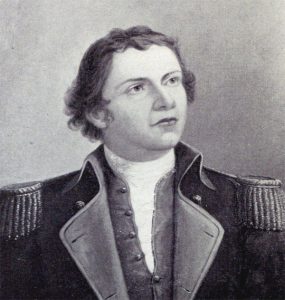
I must begin with General Hugh Mercer, a valiant soldier mortally wounded as he fought in the Battle of Princeton. He was just one among the many hundreds who gave “the last full measure of devotion” for liberty. His sacrifice has been immortalized in the paintings by John Trumbull (Yale University Art Gallery) and Charles Willson Peale (Princeton University Art Museum). In his honor, our county is named Mercer County. Hugh Mercer’s descendants have honored his sacrifice with their lives. His son, William “Billy” Mercer, though born deaf and unable to speak, studied painting with the Peale family in Philadelphia and became a talented artist (Virginia Museum of History and Culture, Philadelphia Museum of Art). Other descendants became army officers, attorneys, and politicians. Hugh Mercer’s skill and patriotism are evident in his three-times great grandson, the noted hero of World War II, General George S. Patton. On a lighter side, another great-grandson, Johnny Mercer, would give us such songs as “Hurray for Hollywood”, “Autumn Leaves”, and “Moon River”. Each descendant had the freedom to choose his own path in his own way. The excellence of their success celebrates the valor of Hugh Mercer and revolutionary heart of Princeton.
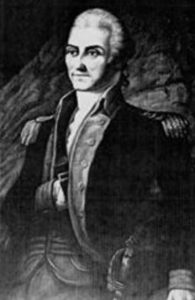
Francis Barber, born 1750 perhaps in Princeton but reared in New York State, was a graduate of the College of New Jersey (1767). Francis Barber left college to become the Rector of the Academy of Elizabethtown still standing as it always has as a place of learning, building character and community service since the time of Barber. This patriot laid his career and loved ones aside to serve valiantly as a soldier in the Continental Army even being wounded many times in New Jersey, Pennsylvania, New York and Virginia. He joined the army in 1776 and quickly rose in rank to become a colonel. He took part in bringing down the Blue Mountain Valley, a British military ship loaded with supplies destined for New York, when it was captured and burned at Sandy Hook. He served under General von Steuben at Valley Forge during the winter of 1777-78. Barber served as Major General Layette’s aide-de-camp at Yorktown, where he witnessed the surrender of General Cornwallis. Barber sacrificed so his descendants who were clergymen, attorneys, politicians (one a mayor of Newark), a bank President, and following in his ancestors’ footsteps, the Head Master of a New York City School, would be free. His great granddaughter would experience in Washington D.C. one of the most tragic events America had known up to that time – the assassination of Abraham Lincoln. Francis Barber carried the spirit of Princeton with him throughout the Revolution. His dedication continued in his descendants through the generations each working to build this new country upon the revolutionary heart of Princeton.
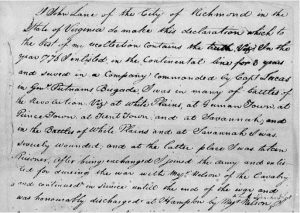
John Lane, born in Virginia, worked on river barges hauling tobacco with his father. At the age of 16, the minimum age to enter military service, John Lane joined in patriotic service and would spend the next years fighting in New England, New York, New Jersey (at the Battle of Princeton), Pennsylvania, Georgia, and Virginia. John’s wife, Anna Maria Lane, accompanied John but instead of cooking and washing as other wives, she donned a soldier’s uniform and fought alongside her husband. After the end of the war, service continued as John worked in the Public Guard while Anna Maria worked as a nurse. For his service, John received a pension of £40 a year. And Anna Maria? The State of Virginia determined that because of her “extraordinary military services,” she would be awarded a pension of £100 a year! As you walk through Princeton, remember the whole-hearted commitment of John and Anna Maria Lane. Let the revolutionary heart of Princeton that exemplified their lives undergird your American heart.
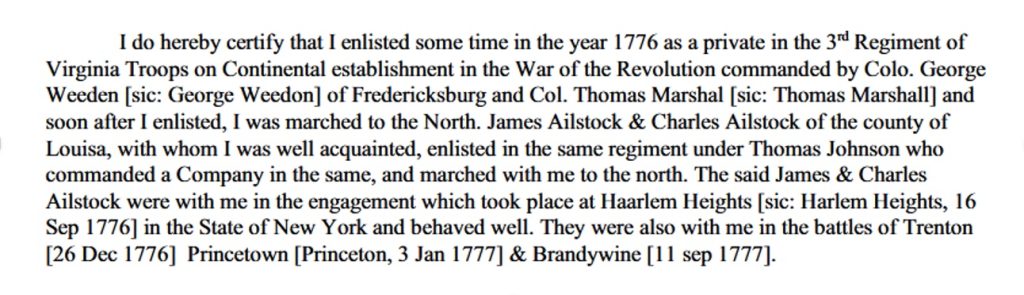
No story of the revolution in Princeton would be complete without honoring the many men of color who fought in the fields of Princeton. In 1776, Charles and James Ailstock, brothers from Louisa County, Virginia and free men of color enlisted and battled alongside white soldiers in Harlem Heights (New York) as well as in the battles of Trenton, Princeton, and Brandywine (Pennsylvania). Both received pensions from the State of Virginia. Their father joined the Continental Army as a drummer, and an older brother, Absolom, received a pension for his service during the siege of Yorktown. The Ailstock father and brothers, in spite of enduring the social and political conditions of their “free” status in Virginia, believed freedom was worth fighting for. They proved in their lives the faithfulness of their hearts to the notion of freedom as a human concept that belonged to everyone regardless of their status as free or slave. After the war and though continuing to face racial struggles, the Ailstocks, father Michael and his eleven children, would own land, marry and live as free men and women. They left property, household goods and money to their children and grandchildren. Because of the heroic efforts of the Ailstocks, and especially of Charles and James Ailstock during the Battle of Princeton, the battlefields of Princeton continue as a reminder that liberty is the right of every American. This is the true revolutionary heart of Princeton.
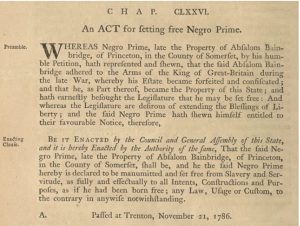
Prime was the name of a slave in the house of Dr. Absolom Bainbridge which still stands on Nassau Street in Princeton. Dr. Bainbridge, loyal to the British, removed to New York City after the Battle of Princeton. Prime managed to escape and return to Princeton where he was under the charge of Jacob Bergen, County Commissioner. Morally, Bergen could not sell Prime because he would be “setting up [Prime] to Sale like a Beast of the Stall.” Risking his reputation and his career, Bergen wrote the governor that “there was something very inconsistent in contending for Liberty under an appeal to Heaven and at the same Time selling for account of the Publick, the Bodies and Service of human Beings into perpetual Bondage.” Prime was freed and became a waggoneer in the Continental Army. Later, his freedom would be compromised again when a white man declared he was the rightful owner of Prime. In the end, Prime would gain his freedom a second time from the New Jersey State Legislature. Nothing more is known of Prime or his life, but his story must remind us not only of this ugly side of America’s history, but of those in Princeton who lived lives dedicated to the support of human rights. When we look at Dr. Bainbridge’s house today, we must continue to take up the mantle to secure the full rights of America for every American in support of Princeton’s revolutionary heart.
And my patriot ancestors, as well, though serving outside New Jersey, exemplified the same revolutionary heart of Princeton in their lives. The National Society of the Daughters of the American Revolution recognizes three types of service: Military Service, Patriotic Service and Civil Service. I have patriot ancestors who served in each of these ways. What thrills me the most is seeing how my patriot ancestors have helped to shape who I have become.
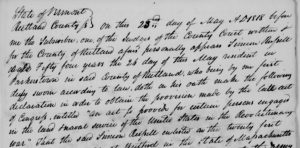
Simeon Russell, born and raised in Vermont, joined the Continental Army in Massachusetts as a private and was discharged at West Point. For his service, Russell received a pension. His revolutionary spirit passed through his descendants as his sons and daughter and grandchildren bought and sold land, became well-established in their towns and were well-respected. His grandchildren moved west to Chicago and Missouri and Nebraska settling in as the country continued to grow. Like Russel, his great, great grandson served as a private in the army, but this time in the Civil War. The Military Service of Simeon Russell, like the revolutionary heart of Princeton, is evident through the generations to today.
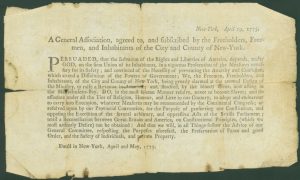
Jonas Rogers, as a member of the Suffolk County, [Long Island] New York delegation, signed the Articles of Association, 1775 on May 8, 1775. He was selected to be a member of the War Committee on January 20,1776 noted to be “substantial free holder and devoted to the cause of the colonies.” He was known to have smuggled goods out of Long Island to Connecticut to aid the “rebels.” It is interesting, that in this period of harsh British occupation, Rogers signed papers pledging allegiance to the British King. This sort of flip-flop between smuggling supplies to revolutionaries and swearing allegiance to the king was common for him. In order to continue his patriotic service, he did what was required of him so that his actions would remain unnoticed by the British Army. Having fully supported the war for independence, Rogers returned to farming faithfully paying the taxes due on his land and possessions until his death at age 95 in 1818. Jonas Rogers in his Patriotic Service exemplified the same revolutionary heart known in Princeton. His great grandson, Alonzo Rogers, served for the North in the Civil War fighting in the second Battle of Bull Run during which he was severely injured and remained lying on the battlefield three days before being rescued. Certainly, Alonzo Rogers shared in the revolutionary heart of Princeton putting his life on the line. After the war, he continued his adventure by sailing around the world three times before marrying and raising eight children (one son, a local politician).
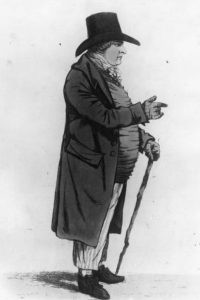
Moses Hemingway was born and died in New Haven, Connecticut. Not much is known of his military service during the revolution. Yet, his hometown paid a great price for freedom as British troops marched through sacking it, burning buildings and houses and killing patriot citizens. After independence, Hemingway served his town as a tythingman elected as a peace officer in efforts to rebuild New Haven. In his Civic Service, Moses Hemingway was dedicated to the same revolutionary heart as Princeton. One of my favorite of his descendants is my great, great uncle, Charles A Platt. A railroad man, he became the manager of the old Grand Central Station and then, a superintendent of the New York-New Haven Railroad. Interested in modernizing the American railroad, he attended an international railroad conference in London. The queen carrying on the railroad passions of her late husband, Prince Albert, invited the convention representatives to an afternoon at Windsor Castle. He certainly saw Queen Victoria as she greeted her guests! In his service to New York in making the railroads safer and more efficient, Charles Platt continued the revolutionary heart of Princeton.
Independence! Liberty! Freedom! The members of the Princeton Chapter Daughters of the American Revolution believe that their patriot legacy continues to live through them. They look at the buildings and streets and land of Princeton and are humbled by the history they see. They seek to honor their patriot ancestors whose legacy they carry with them understanding it is their obligation to protect that legacy for the generations to come. Our chapter name honors the “battle that saved the revolution” on the fields of Princeton.
Furthermore, we, the residents of Princeton, must never forget Princeton’s contribution to the fight for freedom. May each of us make Princeton’s sacrifice our sacrifice as we guard the revolutionary heart of Princeton.

Constance N. Wieler, a 35-year resident of Princeton, serves as the Chaplain of the Princeton Chapter, Daughters of the American Revolution. Constance, with the assistance of the Princeton DAR board, is working to publish a commemorative edition of a book about Washington at Rockingham written and first published by the chapter in 1958. Constance is also a Trustee of the Princeton Battlefield Society. She loves researching her ancestors who first came to this land in the early 1600’s and takes a special interest in her patriot ancestors. Constance has a theological degree and has taught in Princeton, throughout the US and around the world.